
What Is an AI Agent Framework
An AI agent framework is the software layer that helps developers build, run, and manage agent behavior, tools, memory, and execution flow.
This guide explains what an AI agent framework is, what it actually does in practice, and when a team needs one instead of a simpler workflow builder or SDK.
Related Tools

Details
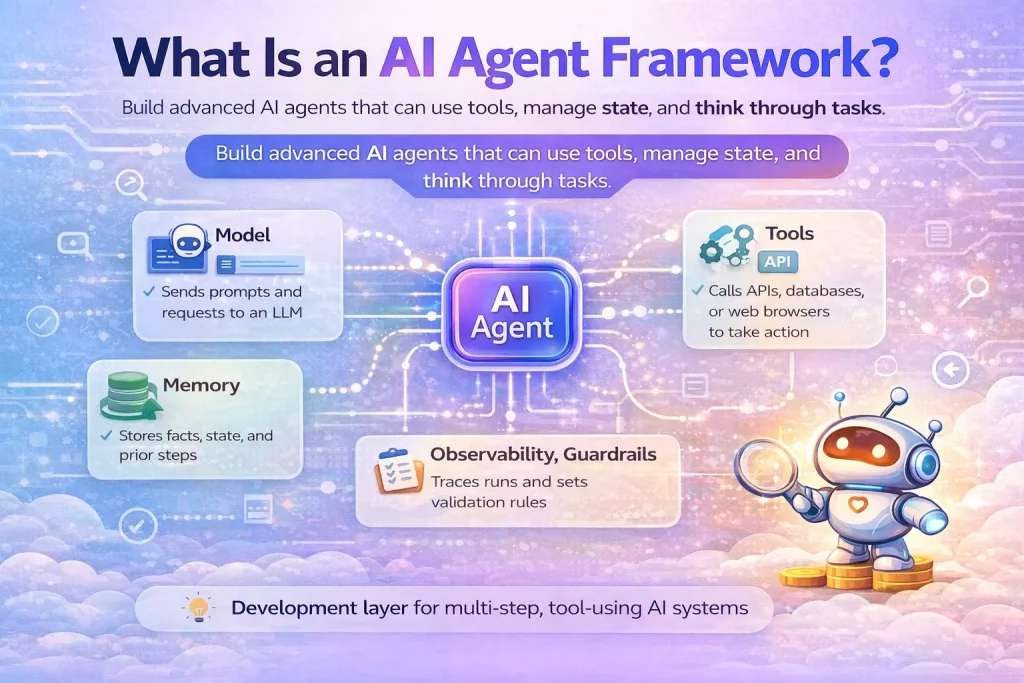
An AI agent framework is a development layer for building agents that can reason over tasks, call tools, manage state, and coordinate multi-step execution. In practice, it gives you structure around model calls, tool use, memory, handoffs, and workflow control so you do not have to wire every loop yourself.
The key idea is that a model alone generates output, while an agent framework helps turn that model into a system that can decide, act, recover context, and interact with outside tools. That matters once you move beyond a single prompt and start building chat agents, research agents, approval flows, or multi-step automations.
What an AI agent framework actually does
Most frameworks provide a runtime for agent behavior. That usually includes tool calling, memory or state handling, routing logic, execution traces, and a way to manage repeated steps. Some frameworks are code-first and aimed at developers. Others are more orchestration-oriented and sit closer to workflow tools.
In a real implementation, the framework is often the glue between your model provider, your tools, your storage layer, and your execution logic. For example, an agent may search a knowledge base, call a CRM API, summarize results, ask for human approval, and then continue execution. The framework keeps that sequence consistent.
Core building blocks
- Model interface: sends prompts and structured requests to one or more LLMs.
- Tool layer: defines what outside actions the agent can take, such as API calls, database reads, or web search.
- State or memory: stores thread context, user facts, or longer-running state.
- Execution control: manages loops, retries, branching, and handoffs.
- Observability: traces runs, tool calls, and errors for debugging.
- Guardrails: constrains unsafe or invalid actions.
Who should care about agent frameworks
Engineering teams building agent products, internal AI tools, AI copilots, or multi-step AI workflows should care. A workflow or app team usually reaches for a framework when it needs more than one prompt plus one tool call. This is especially common in support copilots, research agents, AI operations tooling, and internal process automation with approvals.
Teams that only need deterministic app-to-app automation often do not need an agent framework at all. If your use case is “take a form submission, update HubSpot, and send Slack,” a workflow tool is usually simpler and easier to maintain.
How it differs from nearby concepts
Framework vs model SDK
A model SDK helps you call the model API. An agent framework adds orchestration around tools, state, and multi-step execution.
Framework vs workflow builder
A workflow builder usually gives you explicit steps and deterministic logic. An agent framework is better when the system must decide which tools to use or how to continue based on intermediate results.
Framework vs single chatbot wrapper
A basic chatbot wrapper manages messages and maybe retrieval. An agent framework is designed for more complex action-taking behavior.
Common use cases
- Research agents that gather, compare, and summarize information from multiple tools
- Support agents that inspect account context, generate a draft, then wait for approval
- Internal ops agents that route tasks, query systems, and update records
- Developer agents that call code, search docs, and keep thread state between actions
When not to use one
An agent framework is often unnecessary when the workflow is short, deterministic, and easier to represent as normal automation steps. It can also be too much overhead for very small teams that do not need memory, tracing, handoffs, or persistent execution state. In those cases, a workflow platform or a thin SDK integration may be more sensible.
FAQ
Is an AI agent framework the same as an LLM framework?
No. An LLM framework may cover prompts, chains, or retrieval. An agent framework focuses more on tool use, decision loops, and stateful execution.
Do no-code teams need an AI agent framework?
Usually not first. Most no-code teams should start with workflow tools that now support agent nodes or AI steps.
Can a workflow tool also be part of an agent stack?
Yes. Many teams use a workflow builder for surrounding orchestration and an agent framework for the more dynamic reasoning layer.
Conclusion
An AI agent framework is useful when your AI system must do more than answer one prompt. It becomes valuable once you need tools, state, multi-step execution, and reliable control over how the agent behaves. If you only need deterministic automation, keep the stack simpler. If you need dynamic tool use and deeper orchestration, an agent framework becomes the right layer.
Related Guides
What Is an AI Agent
This guide explains what an AI agent actually is, how it differs from simpler chat or automation setups, and when teams should care about...
Read Guide
Best AI Agent Frameworks for Self-Hosting
This guide compares the best AI agent frameworks for self-hosting, from low-level orchestration runtimes to more opinionated multi-agent frameworks. It focuses on who each...
Read Guide
What Is OpenManus?
This guide explains what OpenManus is, how it fits into the agent tooling landscape, and when it is worth using instead of a hosted...
Read Guide
How to Build Agentic Workflows with Responses API
This tutorial explains how to build agentic workflows with the Responses API, including tool design, state decisions, approvals, and validation. It is aimed at...
Read Guide
How AI Agents Work
This guide breaks down how AI agents work at an operational level so you can understand the model, tool, state, and orchestration loop behind...
Read Guide
Core Components of an AI Agent
This guide explains the core components of an AI agent and why each one matters in real implementations. It focuses on architecture choices that...
Read Guide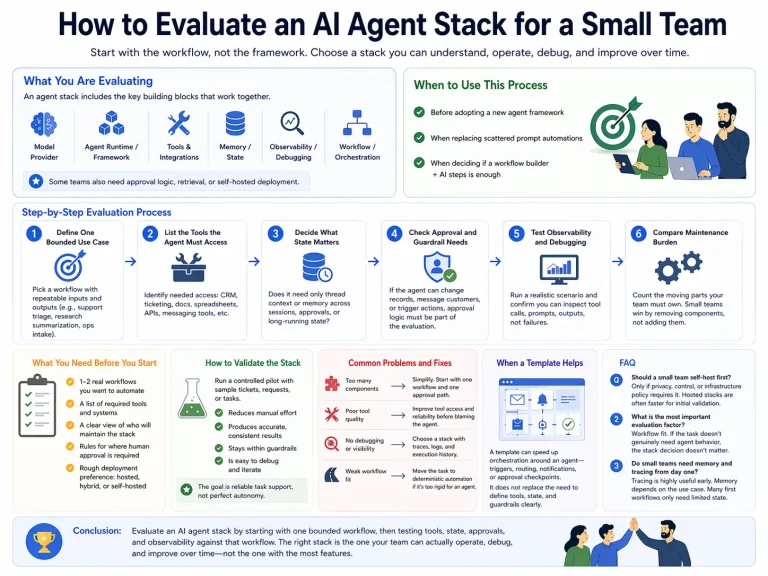
How to Evaluate an AI Agent Stack for a Small Team
This guide shows how a small team can evaluate an AI agent stack without overbuying complexity or choosing tools it cannot realistically operate.
Read Guide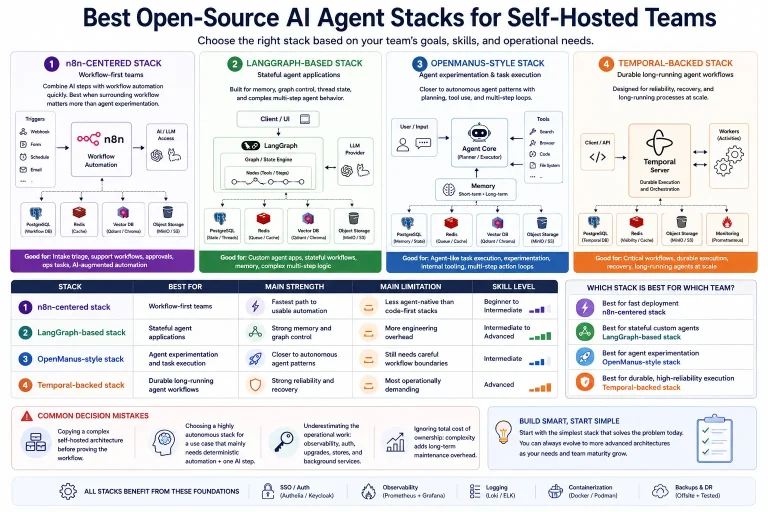
Best Open-Source AI Agent Stacks for Self-Hosted Teams
This guide compares the best open-source AI agent stacks for self-hosted teams and helps you choose based on control, complexity, and operational fit.
Read Guide