
How to Use MCP Tools in Make AI Agents

A practical guide to adding MCP-based tools to Make AI Agents and deciding when they fit better than scenarios or modules.

This guide explains how to use MCP tools in Make AI Agents and where they fit in Make’s current tool model. It focuses on setup, tool selection, instructions, and the tradeoffs versus scenario tools and module tools.

Difficulty Intermediate
Read Time 10 minutes

Related Tools

Details

In Make AI Agents, MCP tools let your agent access external tools exposed through an MCP server. That matters when the agent needs capabilities that are not already covered by a simple module tool or a local Make scenario. Instead of wiring every action directly inside Make, you can let the agent call tools from an MCP server and use the returned data inside its reasoning flow.

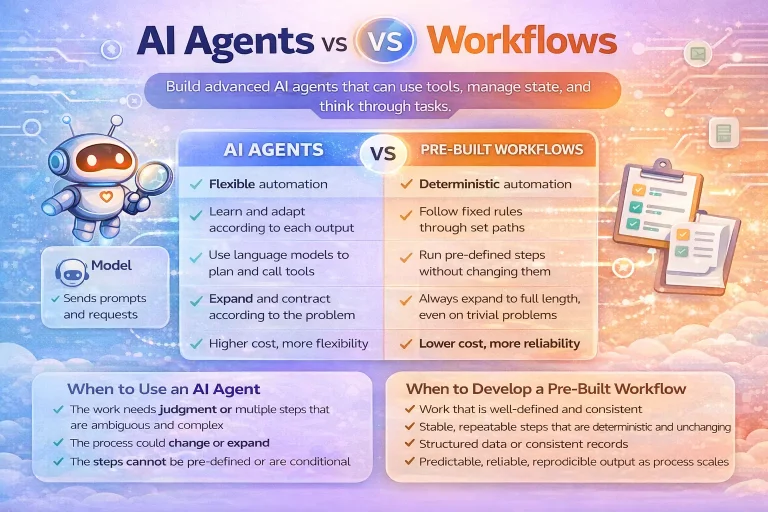
The key decision is not whether MCP tools are “better” than other tool types. In Make, you can give an agent module tools, scenarios, or MCP tools. MCP tools are best when the agent needs access to external tool sets through a standardized interface. Scenarios are better when you need multi-step workflow logic inside Make itself. Module tools are faster for lightweight actions.

What you will build

You will connect an MCP server to a Make AI agent, add selected MCP tools to the agent, describe those tools clearly, test how the agent calls them, and decide where MCP tools fit versus scenarios and modules.

When MCP tools make sense in Make AI Agents

Use MCP tools when the agent needs capabilities provided by an external MCP server or a curated MCP toolbox. Examples include calling a controlled set of support actions, accessing a shared internal search layer, or using a toolbox maintained separately from the agent itself.

Do not default to MCP for every task. If the action is a simple built-in module step, or if the full workflow belongs inside Make, scenario tools are often easier to maintain.

What you need before you start

  • A Make AI agent or a scenario using the Run an agent module.
  • An MCP server or toolbox that is already reachable and authenticated.
  • A shortlist of external tools you actually want the agent to use.
  • Enough clarity to explain when each tool should be called.

Step 1: Decide whether the tool should be MCP, scenario, or module-based

Before adding anything, compare the three tool types available in Make. Module tools are best for quick single-step actions. Scenario tools are best for multi-step workflows with filters and defined inputs and outputs. MCP tools are best when the tool surface is coming from an MCP server rather than from modules built directly into the agent.

If you can solve the job with a simple module or an existing Make scenario, do that first. MCP tools add a new abstraction layer, which is useful only when that layer solves a real access or governance problem.

Step 2: Connect the MCP server

Set up the MCP server connection in the agent flow. The exact server can be Make’s own MCP server, a Make MCP Toolbox, or another compatible remote MCP endpoint. Once connected, Make can discover the tools exposed by that server.

At this stage, do not add every available tool. Start with only the tools the agent needs for one clear workflow.

Step 3: Add the MCP tools to the agent

Add the selected MCP tools to the agent and review their names and descriptions. Tool metadata matters here as much as it does in an external client. Make’s AI agent guidance is explicit that tool names and descriptions influence tool choice. If the tool title is vague, the agent will hesitate or make poor calls.

Keep the tool list small. An overloaded agent with too many similar tools is harder to debug than an agent with a short, well-defined tool menu.

Step 4: Update the agent instructions

Your instructions should mention which tools exist, what they do, and when to use them. If the agent should draft an email only after an external lookup succeeds, say that. If the agent should never use a write tool without first using a lookup tool, say that too.

Good instructions also include examples of expected inputs and outputs. This is especially useful when the tool returns structured fields that the agent needs to reuse later.

Step 5: Test the full decision path

Testing an MCP tool in isolation is not enough. Run the agent with real prompts and inspect whether it chooses the right tool at the right step, maps the inputs correctly, and handles the output without confusion. Watch for two failure modes: the agent ignores the tool, or the agent overuses it.

Common mistakes

Using MCP tools where a simple module tool would do

This adds complexity without adding control. Keep the stack simple unless MCP gives you a real advantage.

Giving the agent too many overlapping tools

Overlap creates poor tool selection. If two tools sound similar, the agent will make inconsistent choices.

Ignoring tool descriptions

The agent chooses tools based on metadata and instructions. Weak descriptions reduce reliability.

Passing too much data into the agent

Make’s AI agent best practices recommend limiting the scope of data the agent processes. Give the tool and the agent only the fields needed for the task.

How to validate the setup

  • The agent can see the MCP tools you intended to expose.
  • It calls the expected tool for a realistic prompt.
  • The returned output is usable by the next step.
  • The agent does not call tools unnecessarily.

When a template helps

Templates help when the surrounding workflow is already known, such as support triage, lead qualification, or AI-assisted drafting. They can save time on routing, prompts, and output handling. What the template will not solve for you is tool governance. You still need to decide which MCP tools belong in the agent and how to describe them.

FAQ

Are MCP tools the same as scenario tools in Make?

No. Scenario tools are built from Make scenarios. MCP tools come from an MCP server and are added to the agent from that external tool surface.

Should I start with MCP tools or scenario tools?

Start with scenario tools if the workflow belongs inside Make. Use MCP tools when standardized external tool access is the main requirement.

How many MCP tools should one agent have?

As few as possible for the task. Start small and expand only when the agent behaves consistently.

What is the biggest reliability factor?

Clear tool names, clear descriptions, and instructions that tell the agent when each tool should or should not be used.

Final notes

MCP tools are most useful in Make AI Agents when they give the agent access to a curated external capability set. They are not a replacement for good workflow design. The agent still needs narrow tool boundaries, limited data access, and clear instructions to behave reliably.

Related Guides