
Single-Agent vs Multi-Agent Systems
A single agent is usually the better default, while multi-agent systems make sense only when responsibilities are truly separable.
This guide compares single-agent and multi-agent designs for practical workflow systems. It focuses on when extra orchestration improves outcomes and when it only adds overhead.
Related Tools

Details
Single-agent systems are the better default for most teams. Multi-agent systems make sense when the work can be split into genuinely different responsibilities—such as planning, retrieval, coding, review, or escalation—and when those boundaries improve quality more than they increase complexity.
If your team is still deciding what tools, context, or stopping conditions the system needs, start with one agent. Multi-agent design is powerful, but it is easier to justify after a single-agent version is already working and its failure modes are understood.
What each option is
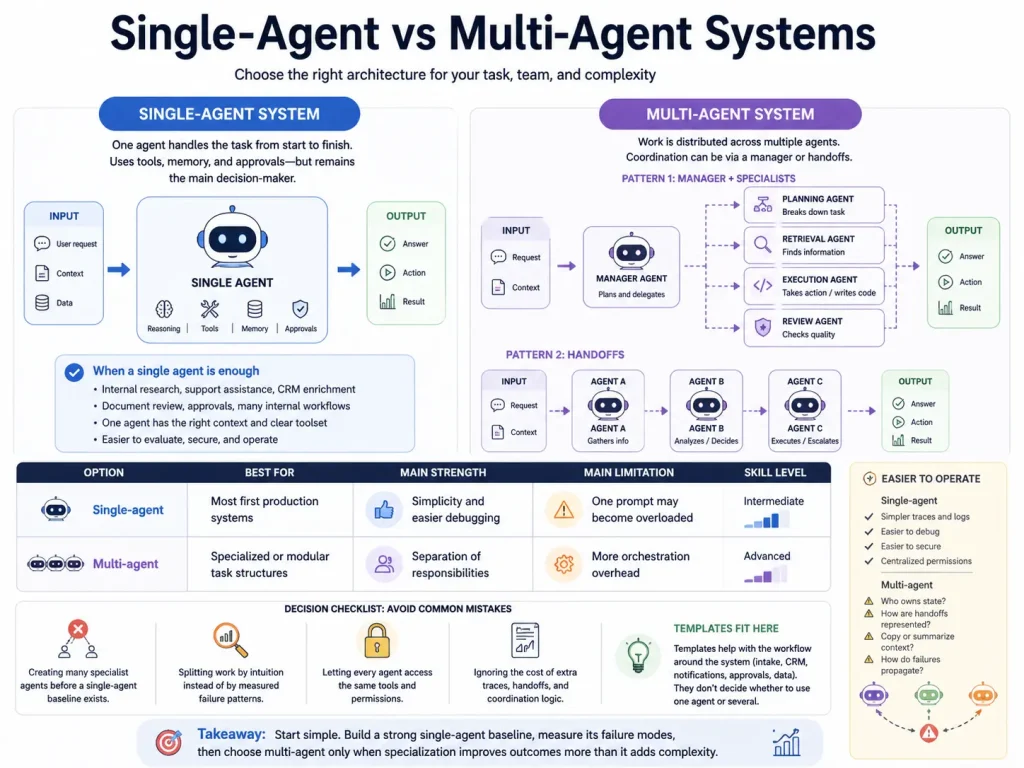
A single-agent system has one main agent that handles the task directly. It may use tools, memory, and approvals, but it remains the main decision-maker throughout the run.
A multi-agent system distributes work across several agents. One pattern uses a manager agent that delegates work to specialists. Another uses handoffs, where one agent passes control to another better suited for the next stage.
Quick comparison table
| Option | Best for | Main strength | Main limitation | Skill level |
|---|---|---|---|---|
| Single-agent | Most first production systems | Simplicity and easier debugging | One prompt may become overloaded | Intermediate |
| Multi-agent | Specialized or modular task structures | Separation of responsibilities | More orchestration overhead | Advanced |
When a single agent is enough
A single agent is often enough for internal research, support assistance, CRM enrichment, document review, and many approval workflows. If one agent can see the right context and choose from a clear toolset, splitting it into multiple agents may not improve anything.
Single-agent designs are easier to evaluate because there is only one decision loop to inspect. They are also easier to secure, since permissions and tool access are centralized.
When multi-agent design becomes useful
Multi-agent systems help when specialization is real, not cosmetic. Examples include a coding workflow where one agent plans changes, another edits files, and another reviews outputs; or a support workflow where one agent gathers account data and another decides whether to escalate.
They are also useful when one agent should not carry all the instructions at once. Separate agents can reduce prompt overload and keep tool access narrower by role.
Which one is easier to operate
Single-agent systems are easier to operate. Traces are simpler, logs are easier to read, and regressions are easier to isolate. This matters more than most teams expect.
Multi-agent systems create new questions: who owns state, how handoffs are represented, whether context should be copied or summarized, and how failures propagate when one specialist gives a bad result to another.
Which one is better for advanced workflows
Multi-agent systems can be better for advanced workflows, but only when the task actually benefits from decomposition. They are not automatically better just because the workflow is large. In some cases, one capable agent with good tools and approval checkpoints performs just as well with less overhead.
Common decision mistakes
- Creating many specialist agents before a single-agent baseline exists.
- Splitting work by intuition instead of by measured failure patterns.
- Letting every agent access the same tools and permissions.
- Ignoring the cost of extra traces, handoffs, and coordination logic.
How templates fit
Templates can help with the workflow around the agent system—ticket intake, CRM updates, notifications, approvals, or data storage. They are less helpful for deciding whether the internal orchestration should use one agent or several. That decision depends on task structure and evaluation results.
FAQ
Should beginners start with multi-agent systems?
No. Start with a single agent, clear tools, and explicit evaluation.
Are handoffs the same as a manager agent?
No. Handoffs transfer responsibility, while a manager-style setup keeps a coordinating layer in charge.
How do I know if I need multiple agents?
If one agent repeatedly struggles because the task contains distinct roles or conflicting instruction sets, multi-agent decomposition may help.
Conclusion
Single-agent systems are the right starting point for most workflow builders. Move to multi-agent design only when specialization improves quality in a measurable way and you are ready to operate the extra complexity.
Related Guides
What Is an AI Agent
This guide explains what an AI agent actually is, how it differs from simpler chat or automation setups, and when teams should care about...
Read Guide
How AI Agents Work
This guide breaks down how AI agents work at an operational level so you can understand the model, tool, state, and orchestration loop behind...
Read Guide
Core Components of an AI Agent
This guide explains the core components of an AI agent and why each one matters in real implementations. It focuses on architecture choices that...
Read Guide
What Is OpenManus?
This guide explains what OpenManus is, how it fits into the agent tooling landscape, and when it is worth using instead of a hosted...
Read Guide
Best AI Agent Frameworks for Self-Hosting
This guide compares the best AI agent frameworks for self-hosting, from low-level orchestration runtimes to more opinionated multi-agent frameworks. It focuses on who each...
Read Guide