
What Is the MCP Registry
The MCP Registry is the official catalog and API for discovering publicly available MCP servers.
This guide explains what the MCP Registry is, why it exists, and how it fits into the broader MCP ecosystem. It is most useful for teams that need a reliable way to publish, find, or manage MCP servers.

Related Tools



Details
The MCP Registry is the official catalog and API for discovering publicly available MCP servers. In simple terms, it is the place where server maintainers publish server metadata and where clients, marketplaces, and other registries can look up available servers in a consistent way.
That matters because MCP adoption creates a discovery problem. Once there are hundreds or thousands of servers, teams need more than a GitHub list or a blog post to know what exists, who maintains it, what it does, and whether it can be trusted for a given use case. The registry exists to standardize distribution and discovery instead of leaving every client and vendor to invent its own listing format.
What problem the registry solves
Without a shared registry, the MCP ecosystem fragments quickly. One client might support a private catalog. Another might scrape GitHub repositories. A third might keep a hard-coded marketplace. That makes discovery inconsistent for users and creates extra work for server maintainers.
The MCP Registry provides a common upstream source of truth for publicly available servers. That does not mean every user will browse the official registry directly. In many cases, clients or organizations will build their own sub-registries on top of it. The value is that they can start from a shared metadata model instead of starting from zero.
How the MCP Registry works
At a practical level, the registry stores server listings and exposes them through an API. Server maintainers can add their servers, and client builders can query registry data when they want to surface MCP servers inside a client or marketplace experience.
The registry is useful at three layers:
- Server maintainers get a standard way to publish discoverable metadata.
- Client builders get a structured source of server data.
- Organizations can build custom public or private sub-registries using the same general approach.
Public and private sub-registries
One of the most important ideas behind the registry is that it is not meant to eliminate other catalogs. Instead, it acts as a primary upstream source that other registries can build on. Public client marketplaces can filter, rank, or enrich the data for their own users. Enterprises can build private registries that apply internal trust, policy, and access rules.
This is useful because the “best” list of MCP servers is different for different contexts. A public hobbyist client may care about popularity and ease of setup. An enterprise team may care about compliance, ownership, and approved data boundaries. The registry supports that diversity by standardizing the source format rather than forcing one universal user experience.
How the registry differs from a GitHub repo of servers
| Approach | Main benefit | Main limitation |
|---|---|---|
| GitHub list | Simple and easy to start | Hard to standardize, query, and govern at scale |
| Client-specific catalog | Tailored experience for one client | Duplicates effort across the ecosystem |
| MCP Registry | Standard discovery layer and API | Still needs downstream curation and trust decisions |
Who should care about the MCP Registry
If you publish MCP servers, the registry matters because discoverability increasingly affects adoption. If you build clients, the registry matters because hand-curating server metadata does not scale. If you run enterprise AI tooling, the registry matters because it gives you an upstream data source for internal allowlists and private marketplaces.
If you are just experimenting with one local server on your own machine, you do not need the registry yet. It becomes important when server discovery, distribution, and governance become operational concerns rather than personal setup details.
Moderation, trust, and governance
The registry is not a guarantee that every listed server is appropriate for every environment. Registry-level moderation can help filter obvious abuse, impersonation, spam, or malicious listings, but organizations still need their own review process before enabling servers broadly. Discovery and trust are related, but they are not the same thing.
That is why the registry is most powerful when paired with additional policy layers such as internal allowlists, approval rules, and deployment standards.
Limitations and tradeoffs
The registry solves discoverability better than it solves quality. It can tell you that a server exists and describe its metadata, but it cannot automatically guarantee that the server fits your security model or workflow requirements. Teams still need evaluation criteria around ownership, permissions, maintenance quality, and operational reliability.
Another tradeoff is that a central registry makes the ecosystem easier to browse, but it also raises expectations around metadata accuracy and moderation. Discovery gets easier; curation work does not disappear.
When templates help
The registry helps you find servers. Templates help you turn those servers into useful workflows. If your goal is not just discovery but implementation, a workflow template can reduce time-to-value by giving you the orchestration around a server, such as approval logic, ticket routing, or CRM update steps. You still need to choose the right server and validate its outputs.
FAQ
Is the MCP Registry the same as an app store?
Not exactly. It serves a similar discovery purpose, but it is better understood as an official catalog and API layer that other marketplaces can build on.
Do private companies need to use the public registry directly?
No. Many organizations will use it as an upstream source or follow the same schema while maintaining a private internal registry.
Does listing in the registry mean a server is safe?
No. Listing improves discovery, not automatic trust. Security review is still required.
Conclusion
The MCP Registry is becoming a core piece of MCP infrastructure because server discovery no longer scales through ad hoc lists. It gives the ecosystem a shared catalog and API while still allowing public marketplaces and private enterprise registries to apply their own policies. If you plan to publish, discover, or govern MCP servers at scale, the registry matters.
Related Guides
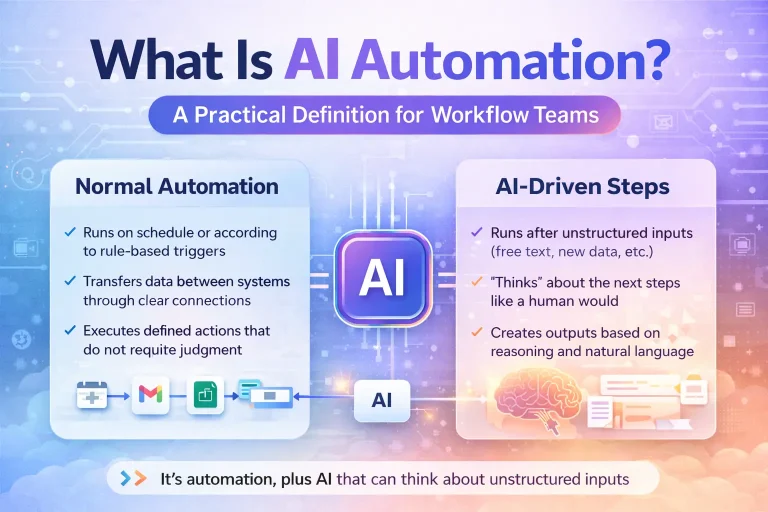
What Is AI Automation? A Practical Definition for Workflow Teams
This guide explains what AI automation actually means for workflow teams, not just in theory but in day-to-day operations. It covers how AI automation...
Read Guide
What Is MCP for AI Workflows?
This guide explains MCP for AI workflows in practical terms, including how it changes tool access, where it fits, and what it does not...
Read Guide
What Is the n8n MCP Server?
This guide explains the n8n MCP server in practical terms, including how it works, what it is for, and where it fits in an...
Read Guide