What Is OpenManus?
An introduction to OpenManus, the open-source framework aimed at building general AI agents with tool integration and community-driven development.
This guide explains what OpenManus is, how it fits into the agent tooling landscape, and when it is worth using instead of a hosted product. It is most useful for people exploring open alternatives to proprietary general-purpose agents.
Related Tools

Details
OpenManus is an open-source framework for building general AI agents. In plain terms, it gives developers a starting point for creating agents that can reason through tasks, connect to external tools and APIs, and be adapted to different behaviors instead of being locked into one product experience.
The practical appeal of OpenManus is that it sits in the open-agent category rather than the closed-agent-product category. If Manus represents a polished proprietary agent experience, OpenManus represents the buildable, inspectable side of the same broader trend: general agents that can act, not just reply.
What does OpenManus do?
OpenManus provides the core pieces you need to assemble a general-purpose agent. The project describes itself as an agent framework with tool integration, which means the focus is not just prompt templating. The framework is meant to help you define agent capabilities, connect those agents to outside tools, and shape how they behave in multi-step tasks.
In practice, that can look like an agent that reads a request, chooses tools, calls APIs, returns a result, and then decides what to do next. The exact workflow depends on how you implement it, but the framework is built to support that pattern.
How does it work?
Like many modern agent frameworks, OpenManus is built around the idea that the model is only one part of the system. The rest of the value comes from orchestration, tool access, and repeatable behaviors. Instead of stopping at a language model response, the framework is meant to let the agent reach into APIs, external utilities, or custom logic.
That distinction matters because many teams discover that prompt engineering alone is not enough once a workflow has branching logic, tool calls, retries, or task decomposition. A framework provides structure for those steps.
Who is OpenManus for?
- Developers who want an open starting point for general AI agents.
- Teams comparing open alternatives to proprietary agent products.
- Builders who care about inspectability and community-driven iteration.
It is not the best fit for users who want the fastest possible out-of-the-box experience. Hosted products usually win on immediate usability. OpenManus is better when you care about control, custom behavior, and the ability to adapt the stack over time.
Common use cases
- Building a custom task agent for internal operations
- Creating a research or browsing assistant with specific tools
- Prototyping a self-hosted alternative to a proprietary agent service
- Experimenting with agent behaviors and tool routing logic
How is OpenManus different from other agent options?
Compared with Manus, OpenManus is more flexible and more transparent, but less polished as a product. Manus is the better choice when speed and convenience matter most. OpenManus is better when you need an agent you can inspect, modify, and potentially self-host.
Compared with LangGraph, OpenManus is more use-case oriented. LangGraph is a lower-level orchestration runtime for long-running, stateful agents. OpenManus is closer to an agent framework that developers can pick up as a practical starting layer for general agents.
Compared with DeerFlow, OpenManus is less specialized around a super-agent harness model. DeerFlow leans into orchestrated sub-agents, memory, sandbox execution, and skills. OpenManus is easier to think of as a flexible open framework for general agents rather than a full harness for complex, long-running multi-capability tasks.
When does it make sense to use OpenManus?
Use OpenManus when you want an open agent stack without starting entirely from scratch. It makes sense when the team wants more control than a hosted product offers, but does not want to design every orchestration primitive from the ground up.
It makes less sense when the job is simple enough for a normal automation workflow or when the team does not have the appetite to maintain an agent stack. Open does not automatically mean lower total effort.
Limitations and misconceptions
The first limitation is maturity tradeoff. Open frameworks move fast, but they can also shift quickly, require more debugging, and leave more integration work to the adopter than commercial products do.
The second limitation is that a framework is not a finished workflow. You still need to define prompts, tool permissions, error handling, and task boundaries. Teams sometimes treat “agent framework” as if it were a ready business solution. It is not.
The third misconception is that open source automatically means better for every team. For some teams, it is better. For others, a hosted product is the faster and cheaper option once setup and maintenance are counted honestly.
FAQ
Is OpenManus the same as Manus?
No. Manus is a proprietary agent product. OpenManus is an open-source framework for building general AI agents.
Is OpenManus beginner-friendly?
Not especially. It is more approachable than building from raw orchestration primitives, but it still assumes a builder mindset.
Can OpenManus be self-hosted?
As an open-source framework, it is much better suited to self-hosted or controlled deployments than a closed SaaS product.
Does OpenManus replace LangGraph?
Not exactly. LangGraph is lower-level and more orchestration-focused. OpenManus is closer to a practical agent framework layer.
Conclusion
OpenManus is useful because it gives builders an open route into general AI agents without forcing them into a closed product. Its strength is flexibility and transparency. Its cost is that you still have to build and maintain the system around it. That makes it a strong choice for technical teams, but not the simplest route for everyone else.
Related Guides
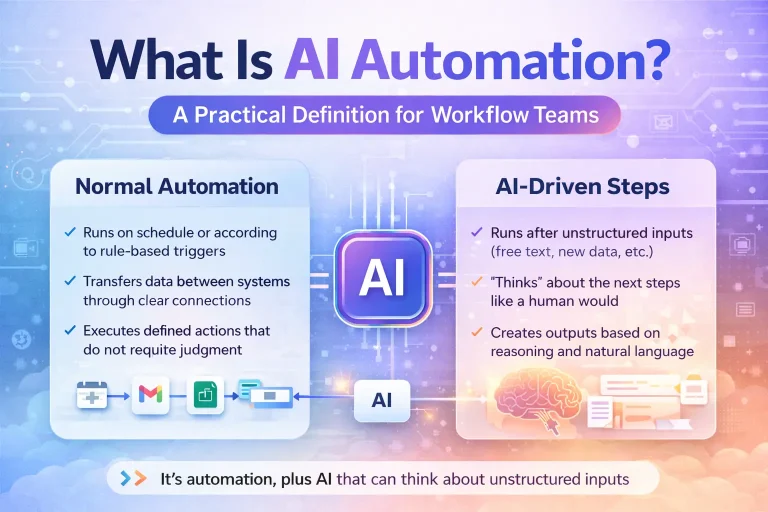
What Is AI Automation? A Practical Definition for Workflow Teams
This guide explains what AI automation actually means for workflow teams, not just in theory but in day-to-day operations. It covers how AI automation...
Read Guide
What Is MCP for AI Workflows?
This guide explains MCP for AI workflows in practical terms, including how it changes tool access, where it fits, and what it does not...
Read Guide
What Is the n8n MCP Server?
This guide explains the n8n MCP server in practical terms, including how it works, what it is for, and where it fits in an...
Read Guide