
What Is Human-in-the-Loop in AI Workflows
A practical explainer of how human review fits into AI workflows and why it matters before automation reaches real systems.
This guide explains what human-in-the-loop means in AI workflows, where review steps belong, and when approval is worth the extra friction. It is most useful for teams moving from AI experiments to production automation.

Related Tools



Details
Human-in-the-loop in AI workflows means adding an explicit human review step before an automated system takes an action that could be costly, irreversible, sensitive, or hard to undo. In practice, that usually means an AI system can draft, classify, score, recommend, or prepare an update, but a person approves, edits, or rejects the action before the workflow continues.
This matters because the weak point in most AI workflows is not text generation by itself. It is execution. Sending an email to the wrong customer, updating the wrong CRM record, publishing flawed content, or approving a payment without context creates operational risk. Human-in-the-loop design keeps the speed of automation for low-risk steps while reserving human judgment for the moments that actually need it.
What human-in-the-loop does in a workflow
A HITL workflow splits work into two layers. The machine handles repeatable, high-volume tasks such as parsing a support ticket, summarizing a document, extracting form data, drafting a message, or proposing a record update. A person only steps in when the workflow reaches a threshold that needs judgment.
- Review AI-generated content before publishing
- Approve outbound customer communication before it is sent
- Confirm CRM changes when an existing record might be overwritten
- Check high-value purchase, refund, or account actions
- Validate tool calls that can modify data or trigger external systems
How it works at a practical level
Most human-in-the-loop workflows follow the same pattern. A trigger starts the automation, AI produces an output or proposes an action, the workflow pauses, a reviewer gets context, and the reviewer approves, edits, or rejects the next step. In n8n, for example, an AI tool call with human review can pause the workflow and send an approval request through Slack, Telegram, or the n8n chat UI. In Zapier, Human in the Loop pauses a Zap so someone can review or edit before the workflow resumes.
- A workflow receives an input such as a form submission, email, ticket, or CRM event.
- An AI step classifies, summarizes, drafts, or decides on the next action.
- The workflow checks risk conditions such as confidence score, dollar value, account status, or data sensitivity.
- If the task is low risk, it can continue automatically. If not, it routes to review.
- A human sees the request, the proposed action, and the relevant context.
- The reviewer approves, edits, or rejects the action.
- The workflow records the decision and either continues or exits.
Who should use HITL workflows
HITL is most useful for teams that want automation but cannot tolerate blind execution. That includes revenue operations teams updating CRM data, support teams triaging tickets, content teams approving AI drafts, finance teams reviewing payment-related actions, and internal operations teams dealing with approvals, routing, or sensitive system updates.
It is less important for deterministic, low-risk automations. If a workflow simply copies a spreadsheet row into another sheet or posts a routine status update, forcing a person into the loop may only slow the process down.
Common use cases
| Use case | What AI does | What the human checks |
|---|---|---|
| Content publishing | Drafts title, summary, and body | Accuracy, brand tone, legal risk |
| CRM automation | Matches or updates lead and account records | Duplicate risk, field mapping, ownership rules |
| Support operations | Classifies and proposes ticket routing | Edge cases, priority, escalation logic |
| Internal ops | Drafts approval notes or change requests | Business policy, stakeholder impact |
| Outbound communication | Drafts email or message | Recipient, claims, timing, compliance |
How HITL differs from full automation
The simplest way to understand the difference is this: automation executes, while HITL automates up to the point where judgment is needed. That makes HITL a design pattern, not a specific product feature. Some platforms expose it as an approval block or a paused run. Others implement it through message queues, review tables, or a custom task inbox.
HITL is also different from manual work. The goal is not to make people do everything. The goal is to reduce the amount of human work to only the steps that benefit from human context.
Common misconceptions
- HITL does not mean reviewing every AI output. That usually creates bottlenecks and defeats the purpose of automation.
- HITL is not only for compliance-heavy industries. Any workflow with customer impact, money movement, or sensitive data can benefit from it.
- HITL is not a permanent crutch. As a workflow matures, some review steps can move from mandatory approval to exception-based review.
When a template helps
A prebuilt template helps when you already know where the review point belongs. For example, content review, ticket approval, and CRM update approval are common patterns. A template can save time on routing, status tracking, and notification logic. It does not remove the need to define your own approval criteria, escalation rules, and audit requirements.
FAQ
Is human-in-the-loop the same as human approval?
Not exactly. Human approval is one common form of HITL, but HITL can also mean editing, correcting, ranking options, or supplying missing context before the workflow continues.
When should I add a human review step?
Add one when the next action is expensive to reverse, could affect customers or regulated data, or depends on context that AI is likely to miss.
Can I remove human review later?
Yes. Many teams start with mandatory approval, then move to exception-based review once the workflow proves reliable.
Is HITL only useful for AI agents?
No. It also applies to simpler AI-assisted automations such as classification, summarization, routing, and record updates.
Conclusion
Human-in-the-loop is the control layer that makes AI workflows usable in real operations. It lets automation handle the repetitive work while preserving human judgment where mistakes are costly. The practical question is not whether to use HITL everywhere. It is where to place the review boundary so the workflow stays fast without becoming reckless.
Related Guides
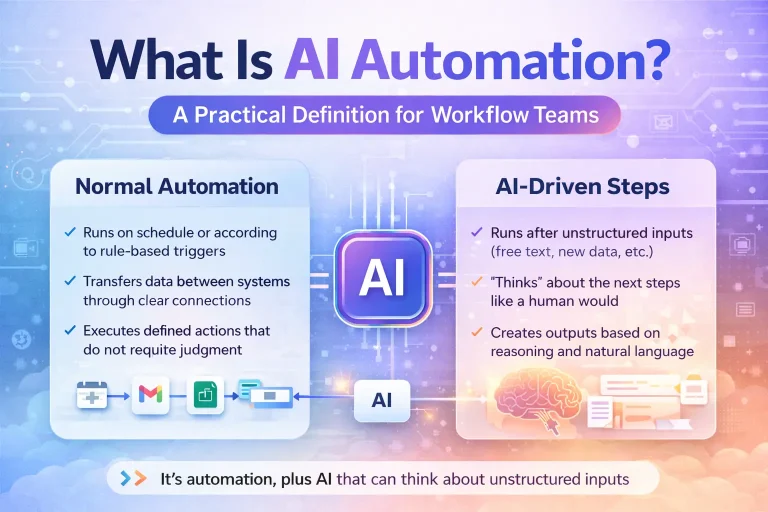
What Is AI Automation? A Practical Definition for Workflow Teams
This guide explains what AI automation actually means for workflow teams, not just in theory but in day-to-day operations. It covers how AI automation...
Read Guide
What Is MCP for AI Workflows?
This guide explains MCP for AI workflows in practical terms, including how it changes tool access, where it fits, and what it does not...
Read Guide
What Is the n8n MCP Server?
This guide explains the n8n MCP server in practical terms, including how it works, what it is for, and where it fits in an...
Read Guide