
What Is an MCP Server
An MCP server is the component that exposes tools, resources, and prompts to an AI client through a standard protocol.
This guide explains what an MCP server is, how it behaves in an MCP connection, and when building one makes sense. It focuses on practical workflow use, not protocol theory.

Related Tools



Details
An MCP server is a service that exposes capabilities to an AI client using the Model Context Protocol. Those capabilities usually include tools the model can call, resources the client can read as context, and prompts the user can invoke intentionally. If MCP is the language of connection, the server is the side that publishes what is available.
In practical workflow terms, an MCP server is the layer that turns a system such as a CRM, database, file store, support platform, or internal API into something an AI assistant can discover and use. Instead of handing the assistant a pile of custom instructions and hand-written function definitions, you expose a stable interface that the client can inspect at runtime.
What an MCP server actually does
An MCP server does not have to be a large platform. It can be a local process, a remote service, or a thin wrapper around an existing backend. Its job is to present useful capabilities in a way an MCP client understands.
- Tools represent executable actions, such as create_ticket, query_orders, or update_lead_status.
- Resources expose structured context, such as docs, files, schemas, or account records.
- Prompts provide reusable templates that a user can trigger for common tasks.
During connection setup, the server declares which capabilities it supports. The client then lists or calls those capabilities using MCP methods rather than relying on app-specific conventions.
Where the server fits in MCP architecture
MCP uses a host-client-server pattern. The host is the AI application. The host creates or manages an MCP client. That client holds a session with one server. A single host can connect to multiple servers, but each client-server connection remains isolated.
This separation matters. It lets a host enforce permissions and consent while each server stays focused on one system or domain. A GitHub server can expose repository tools. A database server can expose read-only query tools. A CRM server can expose customer lookup and update actions. The AI application sees a consistent protocol even though the underlying systems are different.
What makes an MCP server different from a normal API wrapper
A normal API wrapper is built for your application code. An MCP server is built for AI clients. That changes the shape of the interface. Instead of only exposing raw endpoints, an MCP server describes capabilities in a model-friendly way: names, input schemas, descriptions, and discovery methods. It also participates in protocol initialization, capability negotiation, and structured messaging.
That does not mean every API should become an MCP server. If you only need a fixed backend integration for one product feature, a normal API may be enough. MCP servers make more sense when the same capabilities should be reusable across agents or across different AI clients.
Common kinds of MCP servers
| Server type | Typical purpose |
|---|---|
| Knowledge server | Expose docs, policies, specs, or account records as resources |
| Action server | Let the model perform writes such as create, update, or submit operations |
| Developer tooling server | Provide repository access, file operations, database queries, or terminal-adjacent tasks |
| Workflow gateway server | Expose approved workflow steps from an automation platform or internal orchestration layer |
| Read-only reporting server | Let agents retrieve metrics, dashboards, or business summaries without write access |
Who should build an MCP server
You should consider building an MCP server if you own a system that AI clients need to use repeatedly. That includes internal platform teams, product teams building AI features, and automation teams that want to expose approved actions without recreating integrations for every assistant.
You probably do not need to build one if your use case is temporary, your workflow is single-purpose, or you already have a stable one-client integration that will never need reuse.
What a good MCP server looks like
A useful MCP server is narrow enough to be safe and understandable. It should expose well-scoped tools, clear descriptions, and predictable schemas. The best servers do not simply mirror an entire API surface. They publish the few actions and resources that are actually useful in a workflow.
For example, a support server should not expose every backend method just because it can. It is usually better to expose high-value capabilities such as get_ticket, search_customer_history, summarize_thread, and draft_reply, with explicit write actions requiring confirmation.
Limitations and common misunderstandings
An MCP server is not a magic adapter that makes any system instantly agent-ready. You still need to solve authentication, authorization, rate limiting, audit logging, and output quality. Poorly designed tools can still confuse models. Overly broad write permissions can still create risk.
Another common misunderstanding is that one giant server is always better than several smaller ones. In practice, splitting servers by domain often gives clearer security boundaries and cleaner tool design.
When a template helps
If your end goal is a recurring business workflow rather than protocol experimentation, a template can help more than starting with a blank server. A lead-routing or knowledge-search template can reduce setup work by giving you the orchestration and prompt pattern. You still need to configure credentials, field mappings, and any custom logic that reflects your business rules.
FAQ
Can an MCP server be local?
Yes. MCP servers can run locally or remotely. Local servers are common for desktop workflows and development environments.
Can one MCP server expose both tools and resources?
Yes. A server can expose multiple primitives if that fits the use case.
Do I need one server per application?
Not always, but that is often the cleanest design. Group capabilities by security boundary and operational responsibility rather than forcing everything into one server.
Conclusion
An MCP server is the publishing side of MCP. It exposes the actions, context, and guided prompts an AI client can use. If you need reusable, discoverable, model-friendly access to a system, building an MCP server is often the right abstraction. If you only need a one-off backend integration, it may be more infrastructure than you need.
Related Guides
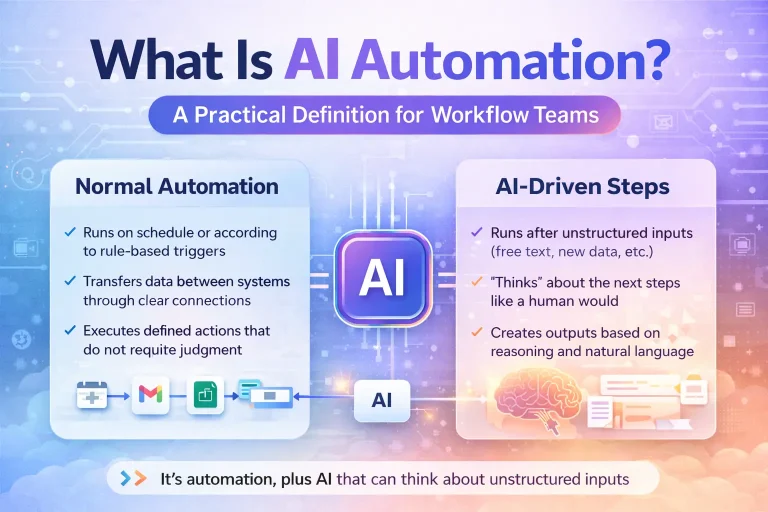
What Is AI Automation? A Practical Definition for Workflow Teams
This guide explains what AI automation actually means for workflow teams, not just in theory but in day-to-day operations. It covers how AI automation...
Read Guide
What Is MCP for AI Workflows?
This guide explains MCP for AI workflows in practical terms, including how it changes tool access, where it fits, and what it does not...
Read Guide
What Is the n8n MCP Server?
This guide explains the n8n MCP server in practical terms, including how it works, what it is for, and where it fits in an...
Read Guide