
Pipedream vs n8n: Which Workflow Builder Fits Better?
A technical comparison of Pipedream and n8n for buyers deciding between code-first event automation and visual workflow control.
This guide compares Pipedream and n8n for technical workflow teams, with a focus on developer experience, visibility, self-hosting, integrations, and pricing logic. It is built to help readers choose the better workflow builder for how their team actually works.
Related Tools


Details
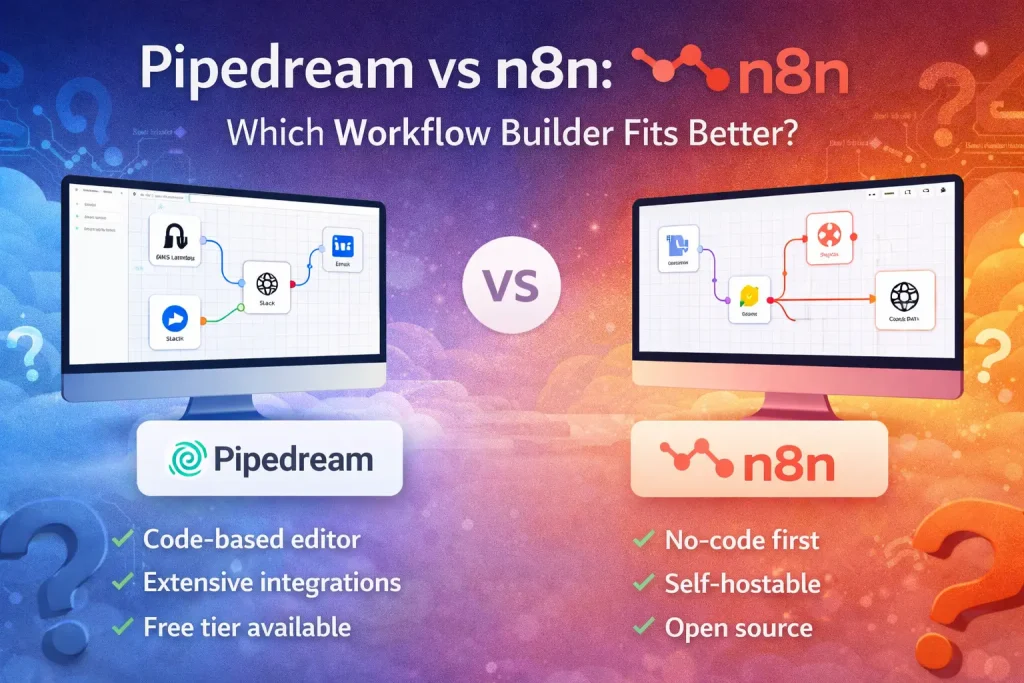
Pipedream is the better workflow builder for developers who want fast, code-friendly, event-driven automation that behaves more like serverless infrastructure. n8n is the better workflow builder for teams that want a visual system with deeper process visibility, stronger self-hosting options, and a more flexible balance between no-code and code. That is the short verdict.
The main difference is not simply code versus no-code. Pipedream is optimized for developers who think in functions, APIs, and runtime behavior. n8n is optimized for technical teams that want to see the whole workflow, adapt it visually, and extend it when needed. Both are powerful. They just fit different builder instincts.
What each platform is
Pipedream is a developer-oriented automation platform with a serverless workflow feel. It is strong for webhooks, APIs, custom code, and backend-style event automation. Its pricing model also reflects that orientation: you pay for compute-like credits, not step count.
n8n is a technical workflow automation platform with a visual builder, code support, self-hosting, and a broad node ecosystem. It is particularly strong when workflows need to be inspectable, adaptable, and shared across a technical team.
Quick comparison table
| Tool | Best for | Main strength | Main limitation | Skill level |
|---|---|---|---|---|
| Pipedream | Developers and API-heavy automation | Code-friendly event-driven workflows | Less visual and intuitive for mixed teams | Advanced |
| n8n | Technical teams needing workflow visibility | Visual flexibility, self-hosting, broad integrations | More setup and maintenance overhead | Intermediate to Advanced |
Ease of use
n8n is easier for most teams because the workflow is visible on a canvas. Branching, AI steps, conditions, and data flow are easier to inspect. That matters for debugging, onboarding, and long-term ownership. It is especially useful when the person maintaining the workflow later is not the person who built it first.
Pipedream is easier only if the builder already thinks like a developer. If you are comfortable with scripts, payloads, event handling, and runtime tuning, it can feel faster than a highly visual tool.
Flexibility and customization
Both platforms are flexible, but in different ways. Pipedream is better when the workflow resembles lightweight backend code. It shines in API glue, webhooks, custom components, and event-driven logic where code is a first-class tool. n8n is better when you want to combine visual composition with code and still preserve clear workflow visibility.
If customization means scripting and runtime control, Pipedream has the edge. If customization means shaping complex workflows across many apps and keeping them understandable, n8n is usually the better fit.
Integrations and ecosystem
n8n has the broader workflow ecosystem advantage because of its node library and community patterns. It is better when the workflow touches many tools across business operations. Pipedream is very strong on APIs and custom integrations, but it is more likely to ask the builder to think programmatically.
Self-hosting and ownership
n8n has the clearer self-hosting story. That matters for teams that care about infrastructure control, data residency, and running automation inside their own environment. Pipedream’s developer experience is strong, but the open-source ownership path is not the same reason people choose it.
Pricing logic
Pipedream charges by compute-style credits tied to runtime and memory. That is often attractive for code-heavy workflows where step-count pricing would be punishing. n8n charges by workflow executions on cloud plans and also offers a self-hosted path, which changes the economics entirely. If you want developer-style usage pricing, Pipedream makes sense. If you want a more inspectable workflow platform with a self-hosted option, n8n gives you more flexibility.
Best fit by use case
Choose Pipedream if
- You are a developer or highly technical builder.
- Your workflows are API-first, event-driven, and code-heavy.
- You want a workflow platform that feels close to serverless infrastructure.
Choose n8n if
- You want technical power with better workflow visibility.
- You need self-hosting or stronger ownership of deployment.
- You expect workflows to be shared, debugged, and modified by a broader technical team.
Common comparison mistakes
The biggest mistake is treating Pipedream and n8n as if they solve the same problem with different UIs. They do overlap, but Pipedream feels closer to developer automation infrastructure, while n8n feels closer to a visual automation platform for technical teams. The second mistake is comparing only subscription prices instead of comparing ownership cost, debugging speed, and workflow maintainability.
FAQ
Which is better for developers?
Pipedream is better for developers who want code-forward workflows and event-driven automation.
Which is better for self-hosting?
n8n is better if self-hosting and infrastructure control are important.
Which is better for team visibility?
n8n is usually better because the workflow is easier to inspect and understand visually.
Bottom line
Pipedream is the better workflow builder for developers who want code-first automation with a serverless feel. n8n is the better workflow builder for technical teams that want visual control, broader workflow ownership, and self-hosting flexibility. Choose Pipedream when developer speed is the priority. Choose n8n when workflow visibility and platform ownership matter more.
Related Guides
Workato Pricing in 2026: What It Really Costs
This guide explains how Workato pricing works in 2026 and what enterprise buyers are actually paying for beyond the surface-level contract. It is designed...
Read Guide
Zapier Pricing in 2026: Plans, Tasks, and True Cost
This guide explains Zapier pricing in 2026 and where the true cost comes from once workflows move beyond simple automations. It is written for...
Read Guide
Gumloop Pricing in 2026: Plans, Credits, and Cost
This guide explains Gumloop pricing in 2026, including plans, credits, concurrency, and where real workflow cost shows up after testing ends. It is written...
Read Guide