
OpenAI Responses API vs Assistants API
A practical comparison of OpenAI’s current API direction versus the older assistant abstraction it is replacing.
This guide compares the OpenAI Responses API and Assistants API so you can decide which one fits a new build, which one is only worth maintaining temporarily, and what the migration tradeoffs look like.
Related Tools

Details
For most new OpenAI integrations in 2026, the Responses API is the better choice than the Assistants API. It is the current direction of the platform, it supports newer agent features such as MCP and computer use, and OpenAI has already deprecated Assistants with a shutdown date of August 26, 2026.
The real decision is not whether Assistants still works today. It does. The practical question is whether you should invest new engineering time into an API that is already on a removal path. In most cases, the answer is no. Responses is the better fit for teams building new products, while Assistants is now mainly relevant for maintaining older integrations long enough to migrate safely.
What each API is
Responses API is OpenAI’s newer response primitive for building model-driven applications. It supports text and image inputs, built-in tools, function calling, and stateful or conversation-based workflows.
Assistants API was OpenAI’s earlier higher-level abstraction for persistent assistants, threads, runs, and tool use. It helped many teams build chat apps and tool-enabled assistants, but OpenAI has now reached feature parity in Responses and is steering developers toward Responses plus Conversations.
Quick comparison table
| Option | Best for | Main strength | Main limitation | Skill level |
|---|---|---|---|---|
| Responses API | New builds, agentic apps, tool-heavy workflows | Current platform direction, built-in tools, simpler mental model | Requires migration if your team is deeply invested in Assistants objects | Intermediate |
| Assistants API | Short-term maintenance of existing integrations | Familiar structure for older assistant apps | Deprecated and scheduled for shutdown on August 26, 2026 | Intermediate |
Main difference
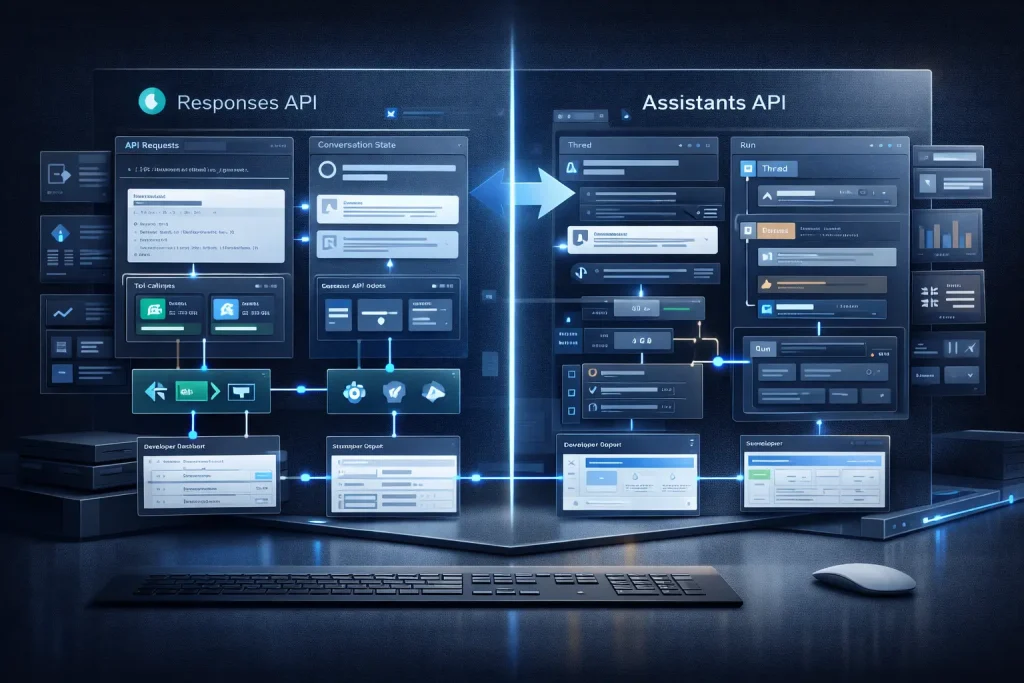
The biggest difference is architectural direction. Assistants was built around assistants, threads, messages, and runs. Responses uses a simpler request-and-items model, and OpenAI now pairs it with the Conversations API when you need durable conversation state. That makes Responses easier to extend into broader agent workflows instead of locking the design around one older object model.
Which one is easier to start with
For a brand-new project, Responses is easier to start with because it matches OpenAI’s current examples, current guides, and current feature rollout. You can begin with a straightforward responses.create call and only add more structure when you need tools, state, or orchestration.
Assistants can still feel familiar if your team already built around threads and runs, but that familiarity is not the same as being a better long-term choice.
Which one is more flexible
Responses is more flexible for modern agent patterns. It supports built-in tools such as web search, file search, computer use, and remote MCP servers, and OpenAI positions it as the base for more agentic applications. That matters if you expect one model request to reason, call multiple tools, use retrieved context, and continue with preserved state.
Assistants handled tools, but its abstraction is no longer the one OpenAI is expanding. If your workflow roadmap includes richer orchestration, Responses gives you more room to grow.
Conversation and state handling
This is one of the more important practical differences. With Assistants, long-running chat behavior was built around threads. With the current stack, OpenAI recommends Responses plus Conversations for persistent state. That means teams migrating off Assistants should plan not just for endpoint changes, but also for how they store and continue multi-turn interactions.
Feature direction and ecosystem fit
OpenAI’s own documentation makes the platform direction clear. Responses is recommended for all new projects, and the migration guides, agents documentation, and newer capabilities all point there first. That changes the ecosystem picture: examples, future API features, and agent tooling increasingly assume Responses rather than Assistants.
Pricing and cost logic
It is safer to think about cost logic than static pricing here. If a platform is the primary API path going forward, it will usually get the best optimization work, the most current examples, and the strongest compatibility path with new models. OpenAI also states that Responses can improve cache utilization and reduce cost compared with comparable Chat Completions flows, which reinforces its role as the preferred primitive.
Who should choose Responses API
- Teams starting a new OpenAI integration
- Builders planning agent workflows with tools
- Products that need a forward-compatible API path
- Teams that want to adopt Conversations for durable state
Who may stay on Assistants briefly
- Teams maintaining an existing production integration during a phased migration
- Products that need continuity while prompts, threads, and tool flows are being mapped into Responses
- Organizations that need to migrate carefully rather than rewrite in one release
Limitations and tradeoffs
The main tradeoff is migration effort. If your app has many assistants, threads, and run-handling assumptions, moving to Responses is not just a search-and-replace. You may need to convert assistant configurations into prompts, move thread logic into Conversations, and update tool invocation patterns.
That said, building net-new functionality on Assistants now usually creates avoidable future work, because the deprecation timeline is already set.
Where templates help
A prebuilt template can reduce setup effort if your use case is already structured, such as document Q&A, ticket summarization, or a tool-calling support assistant. Templates help most with orchestration logic, prompt shape, and output handling. They do not remove the need to update authentication, application state, and tool schemas during a migration.
FAQ
Is the Assistants API already turned off?
No. It is deprecated, but OpenAI’s documented shutdown date is August 26, 2026.
Should I use Assistants for a new app?
Usually no. Responses is the recommended path for new work.
Do I need Conversations if I move to Responses?
You need Conversations when you want durable conversation state across sessions, devices, or jobs. Simple stateless uses can start with Responses alone.
Conclusion
Responses API is the better choice for almost every new OpenAI integration, while Assistants API is now a migration target rather than a strategic foundation. If you are building something new, start with Responses. If you already run on Assistants, plan your migration early instead of waiting for the 2026 shutdown deadline.
Related Guides

Workato Pricing in 2026: What It Really Costs
This guide explains how Workato pricing works in 2026 and what enterprise buyers are actually paying for beyond the surface-level contract. It is designed...
Read Guide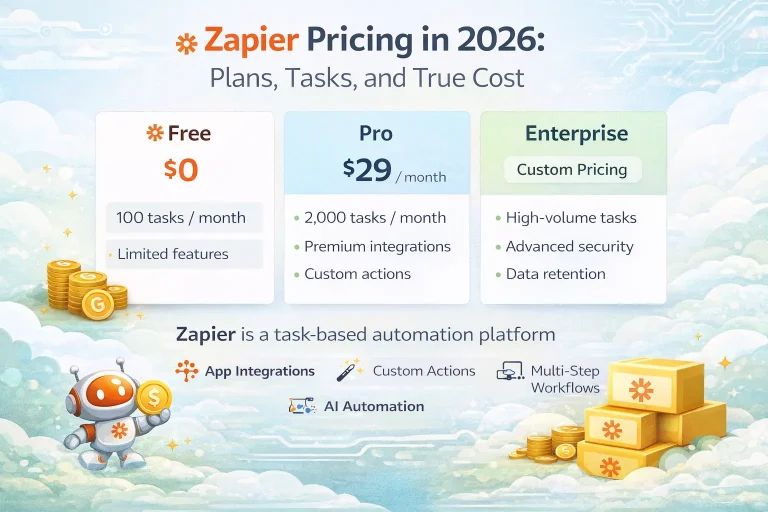
Zapier Pricing in 2026: Plans, Tasks, and True Cost
This guide explains Zapier pricing in 2026 and where the true cost comes from once workflows move beyond simple automations. It is written for...
Read Guide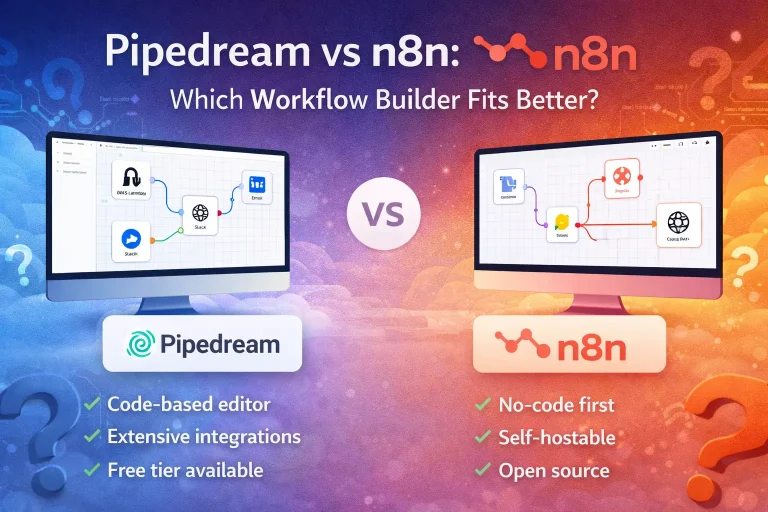
Pipedream vs n8n: Which Workflow Builder Fits Better?
This guide compares Pipedream and n8n for technical workflow teams, with a focus on developer experience, visibility, self-hosting, integrations, and pricing logic. It is...
Read Guide