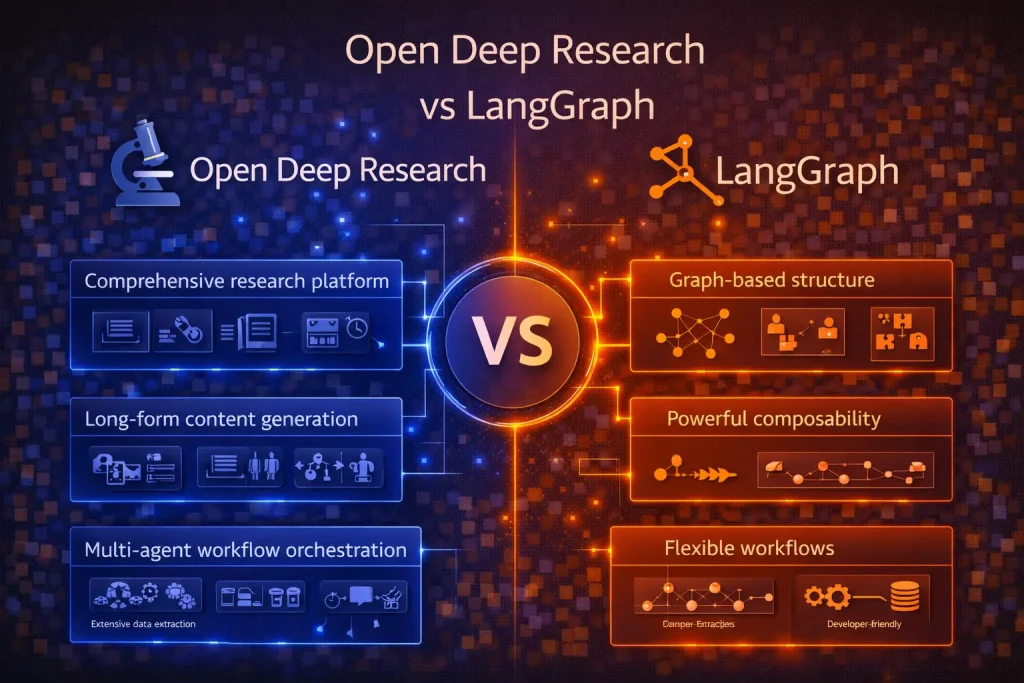
Open Deep Research vs LangGraph
A practical comparison of a research-oriented workflow approach and a code-first agent framework built for custom orchestration.
This guide compares Open Deep Research and LangGraph from the standpoint of workflow speed, customization, and the difference between packaged research systems and developer frameworks.
Related Tools
Details
Open Deep Research and LangGraph solve different problems, so the better choice depends on what you are trying to own. Open Deep Research is more useful as a packaged research workflow or research-oriented system concept. LangGraph is more useful as a developer framework for building custom stateful agent systems.
If your goal is to run a research workflow quickly, Open Deep Research is the closer fit. If your goal is to engineer your own orchestration logic, LangGraph is the better fit.
What each option is
Open Deep Research refers to an open research-oriented workflow or product pattern focused on running research tasks, collecting sources, and producing structured findings. It is easiest to think of it as a higher-level research solution category.
LangGraph is a code-first orchestration framework for building stateful agent systems. It is not a packaged research workflow. It gives developers the control to build one.
Quick comparison table
| Option | Best for | Main strength | Main limitation | Skill level |
|---|---|---|---|---|
| Open Deep Research | Teams that want a research-oriented workflow faster | Closer to a ready-to-use research pattern | Less general as a framework choice | Beginner to Intermediate |
| LangGraph | Teams that want to build custom research agents | Fine-grained control over orchestration and state | Requires more engineering work | Advanced |
Speed vs control
Open Deep Research is usually the better fit when speed matters more than customization. It gives the team a more immediate research-oriented workflow shape.
LangGraph is the better fit when customization matters more than speed. It lets you decide how retrieval, planning, routing, memory, and review should work, but it also means you own those decisions.
Who each option is for
- Choose Open Deep Research if the main goal is to get a research workflow running, test the user experience, and avoid building framework-level orchestration early.
- Choose LangGraph if the team has the engineering resources to build custom research agents and needs durable, stateful orchestration.
Where teams go wrong
- Comparing a research workflow concept to a developer framework as if they were the same product category.
- Choosing a framework before proving the research workflow is useful.
- Choosing a packaged research system when the real need is framework-level control and extensibility.
When templates matter
Templates matter more on the Open Deep Research side because research workflows often repeat recognizable patterns: collect, filter, summarize, and deliver. Templates help validate those flows quickly.
On the LangGraph side, reusable patterns still matter, but the implementation tends to live more in code structure and graph design than in imported workflow templates.
FAQ
Can LangGraph build something like Open Deep Research?
Yes. That is the point of a framework. But you will need to design and implement the research workflow yourself.
Is Open Deep Research better for nontechnical teams?
Usually yes, or at least better for teams that want to validate a research workflow without committing to a framework-heavy build.
Should I start with a framework or a workflow?
Most teams should start with the workflow. Once the workflow is clearly valuable, they can decide whether they need a framework for deeper control.
Conclusion
Open Deep Research is better for getting a research workflow running. LangGraph is better for engineering a custom research system. Choose based on whether you need speed of validation or control of orchestration.
Related Guides
Workato Pricing in 2026: What It Really Costs
This guide explains how Workato pricing works in 2026 and what enterprise buyers are actually paying for beyond the surface-level contract. It is designed...
Read Guide
Zapier Pricing in 2026: Plans, Tasks, and True Cost
This guide explains Zapier pricing in 2026 and where the true cost comes from once workflows move beyond simple automations. It is written for...
Read Guide
Pipedream vs n8n: Which Workflow Builder Fits Better?
This guide compares Pipedream and n8n for technical workflow teams, with a focus on developer experience, visibility, self-hosting, integrations, and pricing logic. It is...
Read Guide