
Best Self-Hosted AI Workflow Tools
A practical comparison of the best self-hosted tools for AI workflows, from accessible automation to engineering-grade orchestration.
This guide compares the best self-hosted AI workflow tools, including where each one fits best for operational AI, internal tools, and more durable orchestration needs.
Related Tools

Details
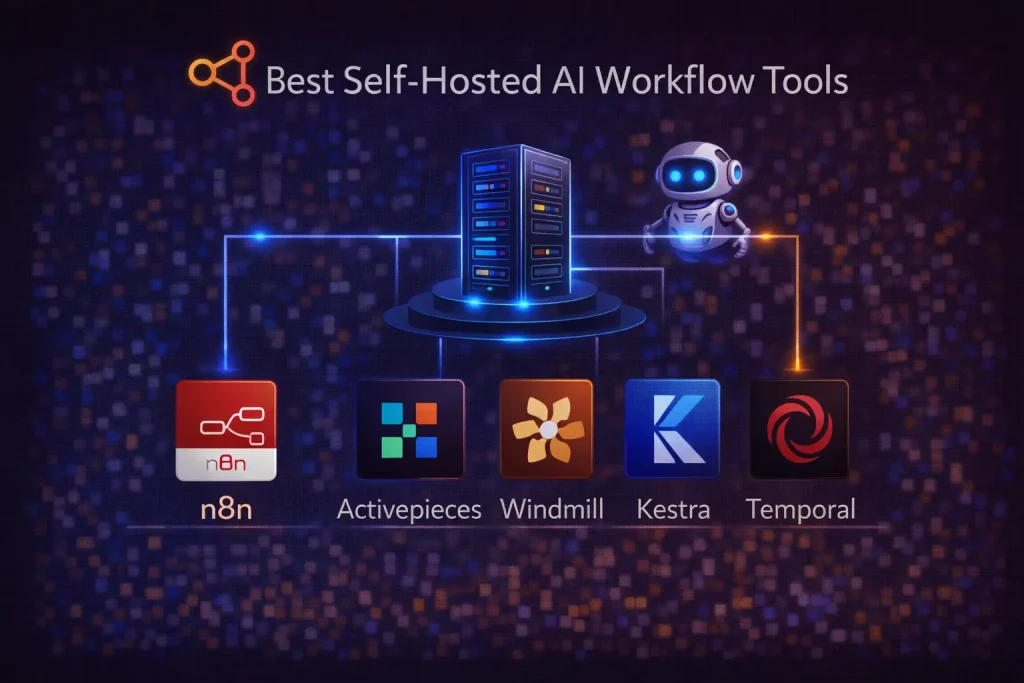
The best self-hosted AI workflow tools right now are n8n, Windmill, Kestra, Activepieces, and Temporal, but they solve different layers of the stack. n8n is the best overall choice for operational AI workflows that connect models to business systems. Windmill is stronger for developer-led internal tools and code-heavy execution. Kestra is better for declarative orchestration across data, AI, and infrastructure. Activepieces is the most approachable for mixed teams that still want a self-hosted option. Temporal is the strongest when durable execution and workflow reliability matter more than no-code usability.
The reason this category is worth separating from general automation tools is that AI workflows behave differently. They often mix model calls, document or API retrieval, branching logic, structured outputs, human review, and downstream actions. A workflow tool that is fine for moving spreadsheet rows may not be the right tool for AI-assisted operations.
How the tools were selected
The tools below were selected based on self-hosting viability, relevance to AI workflows, orchestration capability, fit for real production use, and how well they support the practical layers around AI: inputs, tool calls, validation, handoff, and system actions. The list is intentionally mixed. Some tools are more accessible; some are more engineering-heavy. That is the point.
Summary table
| Tool | Best for | Main strength | Main limitation | Skill level |
|---|---|---|---|---|
| n8n | Operational AI workflows and system-connected agents | Strong integration layer plus AI workflow support | Not the deepest code-first agent framework | Intermediate |
| Windmill | Developer-led AI workflows and internal tools | Code-centric execution and internal tool patterns | Less natural for non-technical operators | Advanced |
| Kestra | Declarative orchestration for AI, data, and infra | Scalable event-driven workflow orchestration | Heavier setup and narrower fit for business users | Advanced |
| Activepieces | Accessible self-hosted AI automation | Easier adoption and broad team fit | Lower engineering ceiling than code-first systems | Beginner to Intermediate |
| Temporal | Durable AI applications and long-running workflows | Reliability, recovery, and workflow durability | Not aimed at visual business automation | Advanced |
1. n8n
n8n is the strongest overall recommendation for self-hosted AI workflows that need to interact with real business systems. Its current product direction includes AI agent positioning, an AI Agent node, and MCP-related capabilities. That makes it more than a classic automation platform and especially useful for AI workflows that need to fetch context, call tools, and trigger actions in operational systems.
Why it made the list: it balances accessibility with enough flexibility to handle real AI-driven workflows. It is particularly good when the workflow needs to connect models with CRMs, databases, spreadsheets, messaging tools, and approval paths.
Main limitation: if your architecture depends on advanced graph-level orchestration or deeply customized agent state handling, n8n is not the strongest technical ceiling.
2. Windmill
Windmill is excellent when AI workflows are owned by developers and tightly connected to internal tools or scripted execution. It turns scripts into workflows, webhooks, and UIs, which is useful for internal AI utilities, data tasks, and operational apps where code remains central.
Why it made the list: some AI workflows need more code than no-code. Windmill is often a better fit when Python or TypeScript logic is part of the normal implementation path, not an exception.
Main limitation: it is less approachable for operator-owned workflows than n8n or Activepieces.
3. Kestra
Kestra belongs on this list because AI workflows increasingly overlap with data and infrastructure orchestration. If your AI pipeline involves event-driven processing, containers, scheduled jobs, API-first orchestration, and larger-scale automation, Kestra becomes a serious option.
Why it made the list: it handles production-grade orchestration patterns well and is open-source and self-hosted.
Main limitation: it is heavier than many teams need for practical business-facing AI workflows.
4. Activepieces
Activepieces is the best recommendation for teams that want an approachable self-hosted tool but still care about AI workflows. Its positioning now explicitly includes AI agents and MCP servers, which makes it relevant to the same broad wave that is helping n8n grow.
Why it made the list: it gives mixed teams a more accessible way to explore self-hosted AI automation without jumping immediately into engineering-first orchestration tools.
Main limitation: it is not where you go first if workflow durability or code-centric architecture is your primary concern.
5. Temporal
Temporal is here for a specific reason: some AI workflows are actually long-running applications with strict durability requirements. If your workflow must survive failures, resume correctly, and guarantee consistent execution across time, Temporal is in a different class.
Why it made the list: it solves the hardest workflow reliability problem better than most platforms on this list.
Main limitation: it is not a practical choice if your team wants fast visual automation or broad operator participation.
Which tool is best for which type of user?
- Best overall self-hosted AI workflow tool: n8n.
- Best for developer-led internal AI utilities: Windmill.
- Best for infrastructure-grade orchestration: Kestra.
- Best for accessible self-hosted adoption: Activepieces.
- Best for durable long-running AI workflows: Temporal.
Tradeoffs and common mistakes
The first mistake is evaluating self-hosted AI workflow tools only on connector count. AI workflows usually fail because of weak validation, brittle prompts, unclear outputs, or poor orchestration between steps, not because one extra connector is missing.
The second mistake is choosing a tool that matches your curiosity rather than your team model. If operators own the workflow, a code-heavy platform may slow adoption. If engineering owns it, a visual-first tool may create friction once the workflow becomes more like software.
The third mistake is assuming a template removes the need for governance. Templates accelerate node layout and structure. They do not solve model safety, human review, or downstream system permissions.
FAQ
What is the best self-hosted AI workflow tool overall?
For most teams building practical AI workflows connected to business systems, n8n is the strongest overall choice.
What is best for developers?
Windmill, Kestra, and Temporal are all strong depending on whether your priority is internal tools, orchestration, or durability.
Do I need a self-hosted tool for AI workflows?
No. But self-hosting becomes attractive when you need infrastructure control, internal system access, or tighter governance around sensitive workflows.
Are these the same as agent frameworks?
Not exactly. Some can support agent workflows, but they are broader orchestration tools rather than pure agent frameworks.
Conclusion
The best self-hosted AI workflow tool depends on where your complexity lives. Choose n8n when you need the best balance of AI workflow capability and operational integration. Choose Windmill or Kestra when the workflow is more engineering-heavy. Choose Activepieces when team accessibility matters. Choose Temporal when durability is the real problem to solve.
Related Guides
Workato Pricing in 2026: What It Really Costs
This guide explains how Workato pricing works in 2026 and what enterprise buyers are actually paying for beyond the surface-level contract. It is designed...
Read Guide
Zapier Pricing in 2026: Plans, Tasks, and True Cost
This guide explains Zapier pricing in 2026 and where the true cost comes from once workflows move beyond simple automations. It is written for...
Read Guide
Pipedream vs n8n: Which Workflow Builder Fits Better?
This guide compares Pipedream and n8n for technical workflow teams, with a focus on developer experience, visibility, self-hosting, integrations, and pricing logic. It is...
Read Guide