
AI Agent Framework vs Workflow Builder
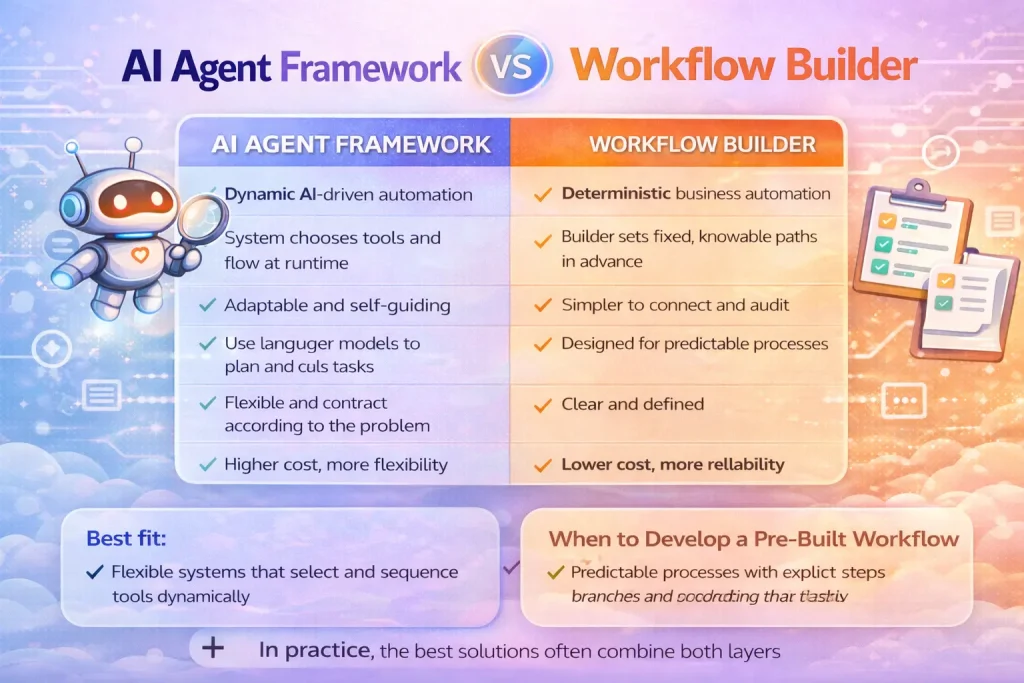
An AI agent framework is better for dynamic, tool-using, stateful AI systems, while a workflow builder is better for explicit, deterministic automation.
This comparison explains the real difference between AI agent frameworks and workflow builders so you can choose the right layer for your team and use case.
Related Tools

Details
If your workflow needs explicit steps, predictable branching, and fast implementation, a workflow builder is usually the better choice. If your system needs to choose tools dynamically, keep conversational or task state, and adapt its path based on intermediate results, an AI agent framework is usually the better fit.
The main difference is control style. A workflow builder gives you a predefined graph of actions. An agent framework gives the model or runtime more decision-making responsibility inside the execution loop. That difference affects speed, reliability, flexibility, and who can maintain the system.
Quick comparison table
| Option | Best for | Main strength | Main limitation | Skill level |
|---|---|---|---|---|
| Workflow builder | Deterministic business automation | Fast to build and audit | Less adaptive in ambiguous situations | Beginner to Intermediate |
| AI agent framework | Dynamic AI systems with tool use | Flexible reasoning and action flow | More complexity and maintenance | Intermediate to Advanced |
What each option is
A workflow builder is a platform like n8n, Make, or Zapier where you define triggers, steps, branches, and outputs directly. It is strongest when the sequence is knowable in advance, even if the workflow is complex.
An AI agent framework is a runtime or software layer that helps an agent decide what to do next, call tools, keep state, and coordinate repeated actions. It is strongest when you cannot fully predefine every path the system will take.
Which one is easier to start with?
Workflow builders are easier for most teams. You can usually connect apps, set triggers, map fields, and add conditional logic without writing much code. That makes them easier to ship for lead routing, approval flows, support triage, CRM sync, and reporting pipelines.
Agent frameworks are slower to stand up because they require more decisions around tools, prompts, memory, evaluation, and failure handling. Even if an SDK makes agent creation simple, production behavior still needs careful design.
Which one is more flexible?
An agent framework is more flexible when the system must interpret a task, choose between tools, and adapt after seeing results. For example, a research assistant that searches multiple sources, compares findings, and decides whether to ask a follow-up question fits an agent framework better than a rigid workflow graph.
A workflow builder is more flexible in a different sense: it makes integrations, branches, and operational steps easier to manage visually. But its strength is controlled orchestration, not autonomous tool selection.
How maintenance differs
Workflow builders are usually easier to audit. You can inspect exactly what the system should do on each branch. That matters for ops, finance, and support processes where reliability and traceability matter more than agent autonomy.
Agent frameworks need stronger observability. You often have to trace tool calls, state updates, and model decisions to understand failures. Without this, debugging becomes guesswork.
Who should choose a workflow builder?
- Ops and RevOps teams automating app-to-app processes
- Support teams routing tickets and approvals
- Teams that need fast implementation and low maintenance
- Builders who want explicit control over each step
Who should choose an agent framework?
- Engineering teams building AI products or internal agent systems
- Teams that need dynamic tool selection and stateful execution
- Systems with research, planning, iterative actions, or handoffs
- Use cases where the exact path cannot be hard-coded up front
Common decision mistakes
A common mistake is using an agent framework for a process that is already deterministic. If you know the trigger, the steps, and the expected outputs, a workflow builder is usually cheaper and easier to maintain.
The opposite mistake is trying to force a highly dynamic task into a rigid workflow. When the system must inspect context, call different tools depending on the request, and revise its path mid-run, a builder alone can become awkward.
FAQ
Can I use both together?
Yes. Many teams use a workflow builder for triggers, routing, and approval layers, then call an agent service or framework for the reasoning-heavy step.
Which one is better for beginners?
A workflow builder is usually better for beginners because the control flow is explicit and easier to debug.
Which one is better for AI copilots?
If the copilot must use tools dynamically and maintain state, an agent framework is usually stronger. If it mostly triggers fixed backend actions, a workflow builder may be enough.
Conclusion
Choose a workflow builder when speed, clarity, and deterministic execution matter most. Choose an agent framework when the system must make tool-use decisions, preserve state, and adapt at runtime. For many teams, the best design is not one or the other but a workflow layer around a narrower agent layer.
Related Guides
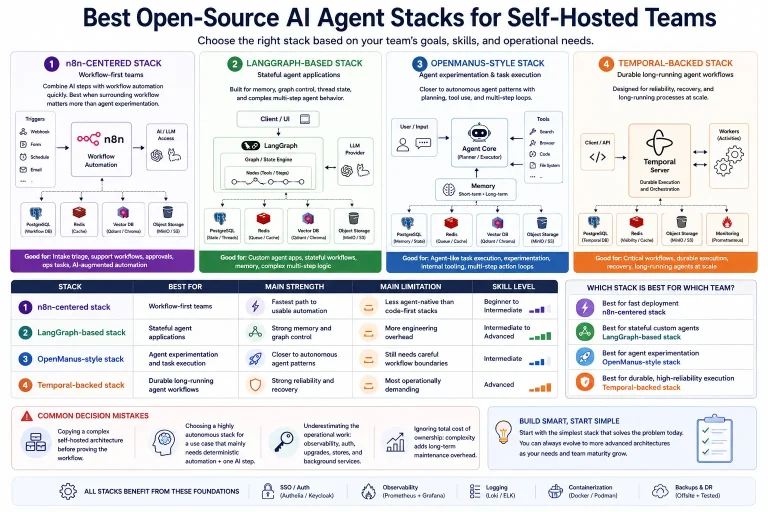
Best Open-Source AI Agent Stacks for Self-Hosted Teams
This guide compares the best open-source AI agent stacks for self-hosted teams and helps you choose based on control, complexity, and operational fit.
Read Guide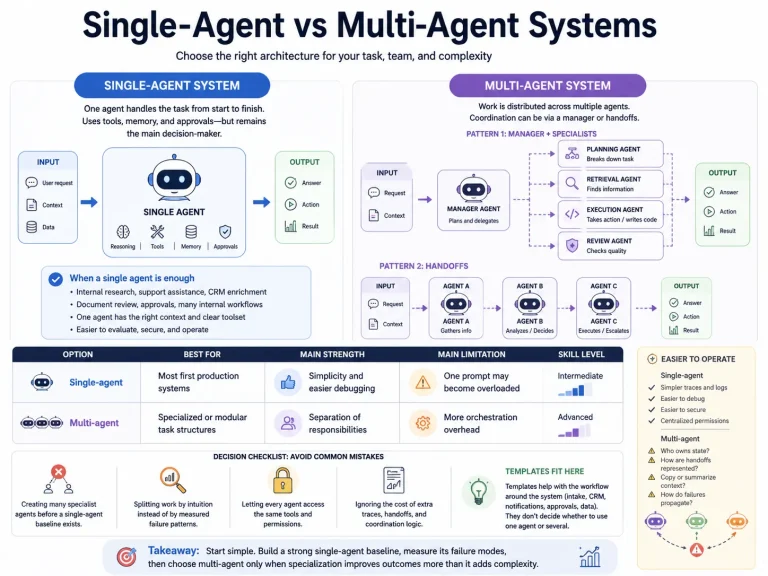
Single-Agent vs Multi-Agent Systems
This guide compares single-agent and multi-agent designs for practical workflow systems. It focuses on when extra orchestration improves outcomes and when it only adds...
Read Guide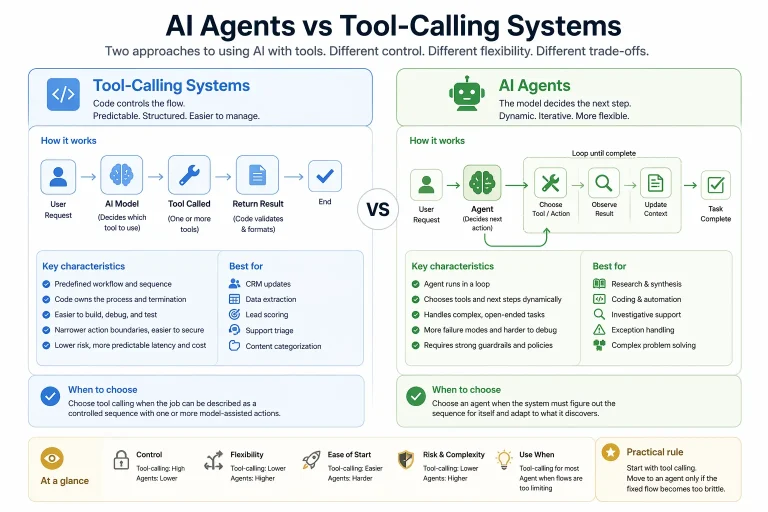
AI Agents vs Tool-Calling Systems
This comparison explains the operational difference between AI agents and tool-calling systems. It is aimed at readers deciding whether they need autonomous orchestration or...
Read Guide